
{PREMIUM} Mutually Assured Destruction (MAD) Returns: Why Trump's Nuclear Weapons Testing Directive To The Secretary of the Department of War Shifts Global Risk Perception Towards More Safety Hedges
This is not just another geopolitical headline—this is a fundamental shift in global risk perception

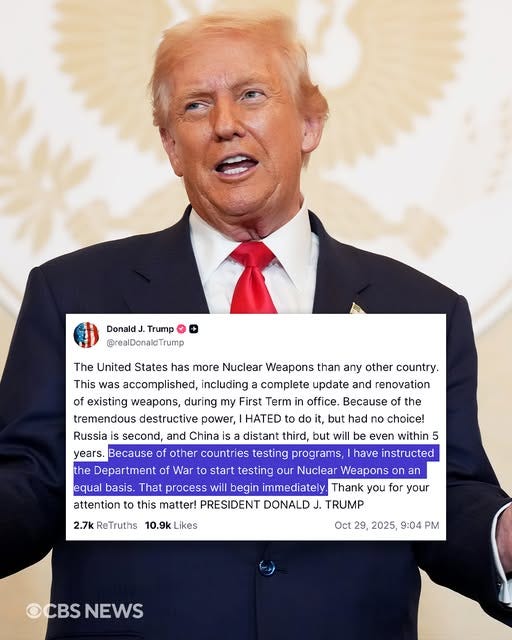
The world changed yesterday. In a move that shatters 32 years of nuclear testing moratorium, President Trump has directed the Pentagon to “immediately” resume full-scale nuclear weapons testing for the first time since 1992.
This is not just another geopolitical headline; this is a fundamental shift in global risk perception that historically drives massive capital flows into the only asset that has preserved wealth through every major conflict in human history: gold.
The implications of this directive extend far beyond military strategy. When the world’s largest nuclear power abandons three decades of restraint and prepares to detonate nuclear devices for the first time since the Cold War ended, it signals that geopolitical risk has reached levels that require the ultimate insurance policy.
That insurance policy is not found in fiat currencies, government bonds, or stock markets; it is found in the 5,000-year-old store of value that has survived every empire, every war, and every monetary crisis in recorded history.
The End of the Post-Cold War Era
Trump’s nuclear testing directive represents the definitive end of the post-Cold War era and the beginning of a new age of great power competition where mutually assured destruction once again becomes the ultimate arbiter of international relations.
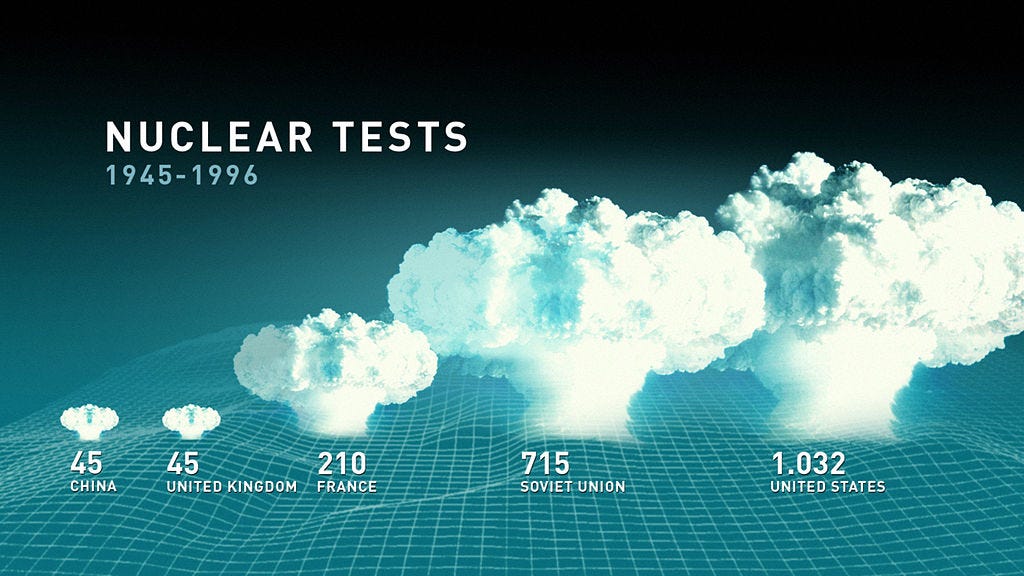
The United States conducted ~1,032 nuclear tests between 1945 and 1992, mostly in Nevada and the Pacific, before Congress imposed a testing moratorium amid growing international pressure for arms control.
The 1996 Comprehensive Nuclear-Test-Ban Treaty (CTBT) banned all explosive nuclear tests, creating a framework that the U.S. signed but never ratified, yet adhered to voluntarily for over three decades.
This voluntary restraint represented the triumph of diplomacy over military posturing, the belief that nuclear weapons could be maintained through computer simulations and non-explosive experiments rather than live detonations.
That era is now over. The directive to resume “immediate” preparation for nuclear testing suggests that tests could begin within months, likely starting with underground detonations of nuclear devices to verify designs, fix aging components, or develop new low-yield tactical weapons for hypersonic missiles.
The Pentagon will need to reactivate infrastructure that has been mothballed but maintained, representing a massive mobilization of resources toward preparation for nuclear conflict.
The psychological impact of this shift cannot be overstated. For an entire generation of investors, the threat of nuclear war has been theoretical rather than practical.
The resumption of nuclear testing makes that threat tangible and immediate, fundamentally altering risk perception in ways that will drive capital flows for years to come.
The Two Scenarios That Both Lead to Gold
The timing and context of President Trump’s nuclear testing directive reveal two possible scenarios, both of which are profoundly bullish for precious metals.
Let’s dig into:
The 2 bullish scenarios
Gold’s performance during nuclear ramp-up’s and crisis
The converging catalysts
The Department of War’s massive resource mobilization
The China factor and safe haven demand
And more…
