

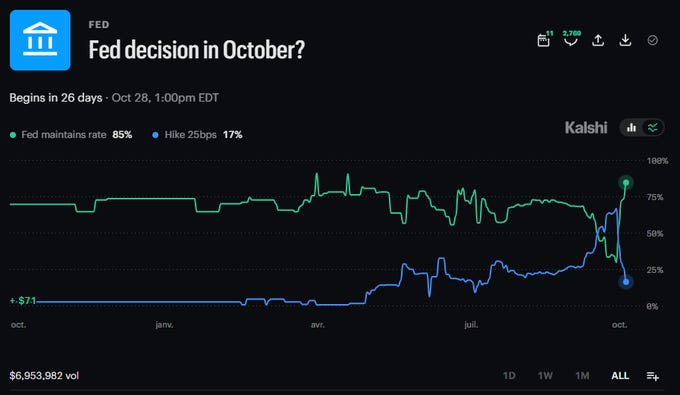
The Federal Reserve just got a reason to wait on raising rates further. Employers added only 29,000 jobs in September. Economists expected about 84,000. Unemployment rose to 4.2%.
After that report, Kalshi, a market where people bet on events, priced an 85% chance the Fed leaves rates unchanged in October. A weak jobs report is how talk of another rate hike loses steam.
Gold had been sold because people thought another hike was coming. An 85% chance of a pause takes some of that pressure off. That is the short-term story. It is not the debt story, which is the long term cloud hanging over everything.
Long-term interest rates are still high for a national debt above $40 trillion. Midterm elections are close. Higher rates will strain housing, company borrowing, and the federal budget. That’s not great for the incumbant.
Now we should be asking if the September rate hike a one-time move? Maybe for this fall. If long-term rates stay near or above 5% while the government keeps borrowing, the administration will still end up buying bonds.
The math dictates it because a 35% of budget interest expense is a non-starter. That is why gold’s bigger reason to rise is money printing, not one soft jobs number.
How the Smart Money Is Paying Attention
Why did 29,000 new jobs and 4.2% unemployment push the chance of an October pause to 85%, and why does that help gold in the short run?
Was the September rate hike a one-time move, or only a pause before the midterms?
Why will high long-term rates still cause trouble, and why does that still lead to money printing and a reason to own gold?
The Fed has a dual mandate and the jobs side showed weakness leading to the market saying another rate in October is off the table. That’s positive for gold in the short run but the generational bullish factor for gold still looms large. So, let’s dig in…
