

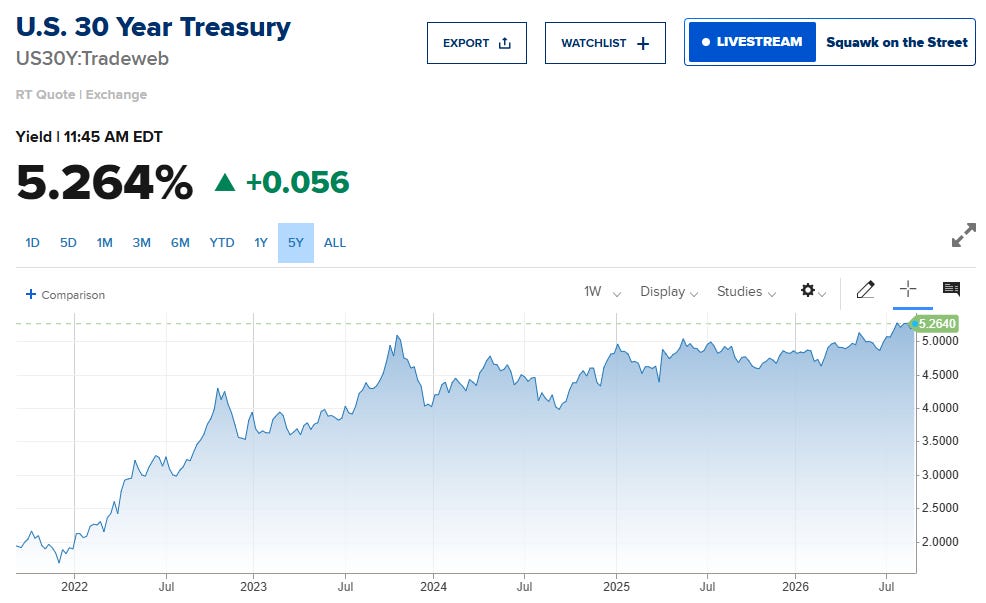
The Federal Reserve still owns the overnight rate. The Treasury is increasingly doing the work that matters on the long end. That is the tell.
Maximum liquidity-support buybacks in the 10-year-to-20-year and 20-year-to-30-year sectors rise from $2 billion to at least $4 billion per operation from September 9 through November 4. Officials have also pointed to the Treasury General Account, near $1 trillion, as firepower that can be used to keep long rates in a range they can live with.
Yen defense sits in the same family of interventions. When the dollar-yen channel threatens to force Japan to sell Treasuries, Washington has a reason to act before the 10-year and 30-year jump and drag everything with them.Public debt outstanding printed $40.033 trillion on August 21.
That stock does not shrink because the Fed talks tough for a morning. It also does not shrink because A.I. CAPEX keeps getting funded with high-quality corporate paper.
First-half 2026 already cleared about $194 billion of A.I.-company bonds against $108 billion in all of 2025. The federal budget is in a large deficit. The A.I. build is being treated as existential in the contest with China.
Neither project survives a long-end accident that freezes capital. They will clearly intervene when they have to. The buyback calendar is only the down payment.
The midterm window is why the next interventions are more likely, not less.
How the Smart Money Is Paying Attention
Why does the Treasury stepping in to cap the long end read as the Fed’s work being done by another shop, rather than as proof the old bond bull has restarted?
What do doubled buybacks, a roughly $1 trillion TGA, and yen-channel defense add that one Jackson Hole speech cannot?
And why does keeping the curve palatable into the midterms debase the currency and still leave gold, silver, and the buildout metals as the go-to’s?
Those questions separate a market-function headline from a regime. Yields can ease when the issuer bids its own paper. The debt stock and the buildout still grow and that’s the tell. So, let’s dig in…
